
Do You Need Two Fideicomisos for Land and a House Built in Mexico?
No, You Don't Need Two Fideicomisos for Your Land and Your House
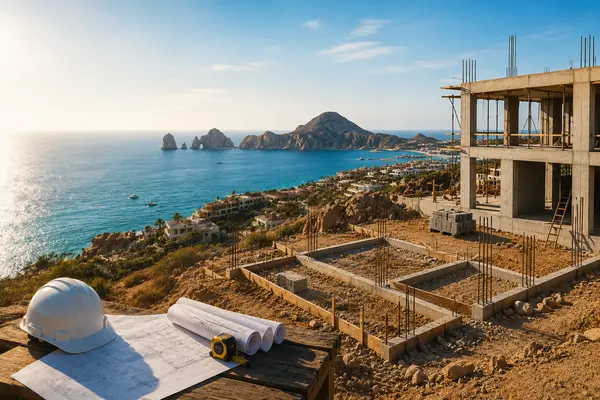
A buyer reached out recently with a question that comes up more than people think: he'd bought a piece of land, spent three or four years building on it, and now wanted to know — does he need a separate fideicomiso for the house, on top of the one he already has for the land?
That's a red flag question. Not because it's a bad question to ask — it's a great one — but because of what it usually means: somebody, somewhere, gave him bad information, or nobody gave him any information at all. So I sat down with Eduardo Tapia, a real estate attorney here in Cabo, to walk through what actually happens when raw land becomes a finished house, and why the trust question isn't the one that should be keeping you up at night.
One Trust, Three Documents
Here's the short answer: no, you don't need a second fideicomiso. The trust you already have on the land covers the house you build on it. What you actually need is three specific documents, filed correctly and in order, that "manifest" the construction onto the existing trust.
Miss that step — and a lot of people do — and you've got a real problem waiting for you at closing, years down the road, when you least want to find it.
Document One: The Construction License
This is the single most important document in the entire process, and it's also where people cut corners without realizing what it costs them later.
When you pull a construction license, you declare an estimated value for the finished home. Say the house will be worth $1 million once it's built. That number matters — it's the baseline the government uses to track that raw land is becoming an improved, more valuable asset.
Here's where it goes wrong. To save a little on permitting dues, some builders convince owners to under-declare — say the build will cost $200,000 instead of $1 million. You save a few dollars on the front end. But you've just created a documentation gap that will cost you far more than you saved when you eventually sell.
Documents Two and Three: Manifestación Catastral and Terminación de Obra
Once construction wraps, two more documents need to be filed — at a different office than the construction license.
The manifestación catastral is filed with the Catastro Municipal, the local property tax records office. It officially updates the record from "raw land" to "improved property." Yes, your property taxes go up — you're now taxed on a house instead of a vacant lot — but that's the point. It closes the gap between what the property actually is and what the paperwork says it is.
The terminación de obra, the termination of works notice, is the final piece. It tells the authorities construction is complete and confirms the final value — in Eduardo's example, the house came in at $900,000 to $1.2 million.
Construction license, manifestación catastral, terminación de obra. Those three documents are, in Eduardo's words, "your Bible" for the construction. Have them, and you're covered. Don't, and the notary handling your eventual sale is going to have questions you don't want to be answering under time pressure.
Why This Actually Matters: Capital Gains
This isn't paperwork for paperwork's sake. When you sell, the notary uses your documented land cost plus your documented construction cost to calculate your capital gains tax. If your construction was never properly manifested, you're sitting on a house that, on paper, doesn't exist. You're paying taxes on raw land while living in — or trying to sell — a finished home.
A Real Example: The Deal Closing Right Now
Eduardo's working a closing right now that shows exactly what happens when this gets skipped. A small teardown beach house, sold to a buyer planning to knock it down and rebuild. The construction was never manifested. The seller had been paying property taxes on raw land for roughly 20 years while a completed house sat on the lot.
The deal was supposed to close in May. As of this conversation, it still hasn't closed — the delay is entirely about fixing decades-old paperwork that should have been filed when the house was finished.
The Cost of Catching Up
Skipping this step doesn't make it go away — it just moves the bill to whoever eventually has to sell.
There's a local fine for filing late, and in Eduardo's experience it runs around 10% — lenient, by his own admission, compared to what comes next. The bigger number is the federal tax exposure. Foreigners are currently facing a flat 35% capital gains rate, and if your construction was never documented, that 35% gets calculated against a much larger, undocumented gain.
The Fix: A Retroactive Appraisal
There is a legitimate way out of this, and it's not cheap, but it works. It's called an avalúo referido — a specialized retroactive appraisal that can only be performed by corredores públicos, licensed public brokers, under Mexican law.
The appraiser essentially travels back in time: what was this asset worth in 2002, or 2003, adjusted for exchange rates, depreciation, and any special features — solar, water treatment systems, custom installations — that would have added value at the time. That retroactive number becomes your documented construction cost, closing the gap between what you paid for land and what the house is actually worth.
Eduardo's used this to bring a $200,000 land-only basis up to $700,000 by retroactively establishing a $500,000 construction value. In one case, a $400,000 appraisal fee saved a client roughly $2 million in tax exposure. That's not a discount — that's just what the legally correct number was all along, finally on paper.
What Not to Do
Eduardo was blunt about the alternative some people try: going to the municipality informally and asking them to "fix" old paperwork off the books. He doesn't recommend it, and neither do I. That route isn't paying the system what you owe — it's paying somebody inside the system to do something irregular. It's the kind of shortcut that turns a fixable paperwork problem into an actual legal liability.
The Takeaway
If you're buying land in Mexico with plans to build, the fideicomiso question isn't the one to worry about. One trust covers both the land and the home you build on it. What you actually need to track — closely, and with a good attorney — are those three documents: construction license, manifestación catastral, terminación de obra.
Skip them, and you're not saving money. You're deferring a bill, with interest, to whoever sells the property next. Sometimes that's you, twenty years from now, trying to close a deal that should have taken thirty days instead of three extra months.
Fletcher Wheaton - fletcher@remexico.com and Eduardo Tapia info@jetzlaw.com
Categories
- All Blogs (217)
- Agent Training (4)
- Cabo Golf (12)
- Cabo Legal (31)
- Cabo Real Estate (97)
- Cabo Restaurants (3)
- Commercial Real Estate in Cabo (4)
- Construction (18)
- Destination News (21)
- East Cape (7)
- Financing (3)
- Land Banking (2)
- Loreto (2)
- Luxury Homes in Cabo (11)
- Market Report (5)
- Mulege (2)
- Neighborhoods (3)
- Pre-Construction (17)
- Residency (2)
- Sports (6)
- Taxes (5)
- Todos Santos (7)
Recent Posts




GET MORE INFORMATION
