
Is there a Zillow in Mexico?
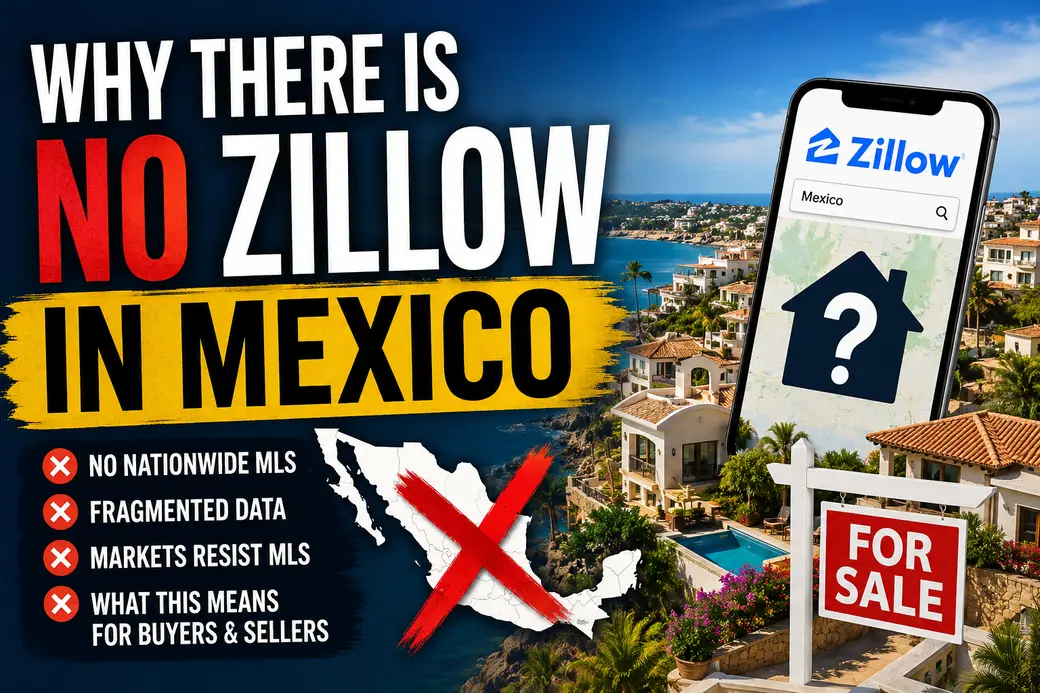
Why There Is No Zillow in Mexico
One of the most common questions foreigners ask when they start looking at real estate in Mexico is:
“Why isn’t there a Zillow for Mexico?”
The short answer is simple:
There is no true Zillow equivalent in Mexico because the data infrastructure does not exist nationwide the way it does in the United States.
A lot of people assume Zillow is simply a website where homes are listed online. But Zillow is really a technology platform built on top of massive amounts of MLS data, public records, sold history, tax information, mapping systems, and brokerage integrations.
That type of centralized system largely does not exist throughout Mexico.
How Zillow Works in the United States
In the United States, Zillow pulls inventory and sales data from hundreds of MLS systems across the country.
While many Americans think there is “one MLS,” there are actually hundreds of regional MLS systems. Depending on the source, there are somewhere between 500 and 800 MLS organizations operating throughout the U.S., although consolidation has reduced that number over time.
The important point is this:
The infrastructure already exists.
Properties are entered into standardized systems. Agents cooperate through shared databases. Sales data is tracked. Historical pricing is stored. Days on market, price reductions, sold prices, taxes, and listing history are all documented.
Zillow simply aggregates and displays much of that information.
Mexico is completely different.
Mexico Does Not Have Nationwide MLS Infrastructure
In Mexico, there are really only a handful of markets with organized MLS systems that resemble what Americans are used to.
Los Cabos has an MLS system.
Puerto Vallarta has one.
Riviera Maya has some MLS style systems.
A few other markets have partial versions.
But once you move outside of those areas, things become much less centralized.
Many cities and regions operate without any formal MLS system at all.
That means there is often:
• No centralized inventory database
• No standardized listing procedures
• No reliable sold data
• No transparent pricing history
• No accurate tracking of days on market
• No universal cooperation between brokerages
Without that infrastructure, building a true Zillow style platform becomes extremely difficult.
The Biggest Problem Is the Data
The issue is not the technology.
The issue is the data.
You can build a beautiful website. You can create maps, search filters, AI tools, and mobile apps.
But if the underlying information is incomplete or inaccurate, the platform becomes unreliable very quickly.
That is the challenge many companies run into when trying to create a “Zillow of Mexico.”
Where are they getting the listings from?
Who is verifying the information?
Who updates sold prices?
Who removes old listings?
Who confirms whether properties are actually available?
Without reliable MLS participation, the data quality breaks down fast.
Why Some Markets Resist MLS Systems
There is another layer to this that many buyers do not realize.
In markets without MLS systems, the largest brokerages often dominate inventory and relationships.
In some cities, there may be eight to ten major brokerages controlling a large percentage of transactions.
Those companies effectively become their own internal listing networks.
From their perspective, a true MLS system can level the playing field.
Instead of controlling access to listings and market information, inventory becomes more transparent and accessible to competitors.
That means not everyone is motivated to support a centralized MLS structure.
This is one of the major reasons why some markets in Mexico have been slow to adopt MLS systems despite the obvious benefits to consumers.
Why This Matters to Buyers and Sellers
For buyers, this means you cannot always rely on online search platforms in Mexico the same way you would in the United States.
Many listings online are outdated.
Some properties may already be sold.
Some listings may appear multiple times with different brokerages and different pricing.
Other opportunities may never appear online at all.
For sellers, this also creates challenges.
Without strong MLS participation and transparent sold data, pricing properties accurately becomes more difficult.
That is one reason why local market expertise matters so much in Mexico.
Understanding inventory trends, knowing which brokerages actually control certain areas, understanding off market opportunities, and having relationships within the market often matters more than simply browsing listings online.
Could Mexico Eventually Have a Zillow?
Possibly.
There are many companies trying to move in that direction.
Technology is improving. MLS adoption is slowly increasing in some markets. Buyers are demanding more transparency. Developers are becoming more sophisticated.
Over time, Mexico will likely continue moving toward better centralized data systems.
But a true nationwide Zillow equivalent still feels far away because the underlying infrastructure is not yet consistent across the country.
Until that changes, real estate in Mexico will continue to be much more relationship driven and locally controlled than what many foreigners are used to in the United States.
Final Thoughts
The lack of a Zillow in Mexico is not because the technology does not exist.
It is because the data systems behind the scenes are fragmented, inconsistent, and in many markets nonexistent.
That creates both challenges and opportunities.
It also reinforces why working with knowledgeable local professionals is so important when buying or selling property in Mexico.
Real estate here is still heavily relationship based, market specific, and often dependent on information that never fully makes it online.
Fletcher Wheaton Cabo Real Estate - fletcher@remexico.com
Categories
- All Blogs (221)
- Agent Training (5)
- Cabo Golf (12)
- Cabo Legal (32)
- Cabo Real Estate (98)
- Cabo Restaurants (3)
- Commercial Real Estate in Cabo (4)
- Construction (18)
- Destination News (21)
- East Cape (7)
- Financing (3)
- Land Banking (2)
- Loreto (2)
- Luxury Homes in Cabo (11)
- Market Report (5)
- Mulege (2)
- Neighborhoods (3)
- Pre-Construction (17)
- Remexico Real Estate Agents (1)
- Residency (2)
- Sports (6)
- Taxes (5)
- Todos Santos (7)
Recent Posts






GET MORE INFORMATION
