
Pre-Construction Real Estate in Cabo
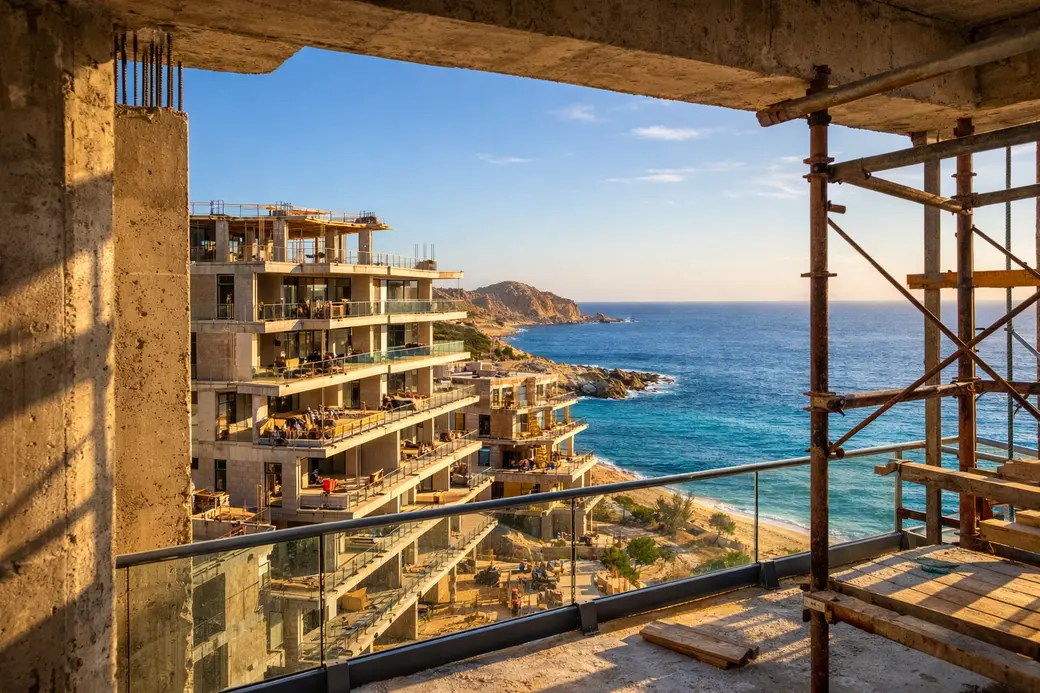
Today we're going to dive into pre-construction real estate market in Los Cabos. We want to get into the nuts and bolts of it and give the audience an idea of what's happening with the pre-construction scene in Cabo. It's been growing a lot, and now it's a completely different environment.
Things have really changed over the last two or three years. The growth continues. The amount of permits being issued by the city has slowed down, but there are still many projects that were already approved. Some are nearing completion, some are halfway through, and many are just getting started. So there’s a wide range of pre-construction. Right now, we’re sitting above all of that—about eight minutes up the hill from Costco, sometimes called the Heights of El Tezal. As you can see behind us, the view is absolutely stunning. And we’re at Torote Restaurant, which is the centerpiece of the Valle del Sol community.
Would you agree with this statement: right now, in 2026, it is the most risky time to be buying ground-up pre-construction in Cabo in the last 10 years—specifically larger condo developments with scale, amenities, and 100+ units?
I would probably rephrase that and say buyers should get very, very well informed. Work with a trustworthy agent to understand who the developer is, what they’ve done in the past, and whether they have a contingency plan if things slow down. Are they relying entirely on presales to build out the development? All of these factors either mitigate or increase risk. The key takeaway is to be extremely well informed before moving forward with pre-construction.
I’ll stand by the statement—it’s risky. Here’s why. First, supply and demand. There are a lot of condos already built and for sale. Developers are coming in trying to sell new two-bedroom units around $400,000, but we can show buyers similar finished units with better views for $100,000 less. That changes the equation immediately.
On top of that, the dollar-to-peso exchange rate has shifted significantly. Inflation has increased material and labor costs. Developers who underwrote projects when the peso was weaker are now facing compressed margins. It simply doesn’t make sense in many cases when buyers can purchase something completed, titled, and ready to use—at a lower price.
From an agent’s perspective, it’s also difficult. A project that was supposed to deliver in two years can end up taking four. The buyer gets frustrated, and while the original intentions were good, delays happen due to slower sales velocity, financing challenges, or increased construction costs. So as an agent, why would you guide a client toward a project that may take four years, when they can buy something finished today for less money and less risk?
We’re also seeing a lot of resales from buyers who purchased during the pandemic. Many of them have equity gains and can sell below current developer pricing while still making a profit. That creates additional competition for new developments.
You mentioned something important: increased material costs, labor costs, and the strengthening peso. Cabo is essentially an island—everything is imported. If four or five years ago a dollar bought five cinder blocks, today it might only buy four. Multiply that across an entire development, and it has a massive impact on profitability and timelines.
Even if a developer successfully completed a previous project, that doesn’t guarantee the next one will go smoothly. It increases the probability of success, but it’s still a different economic climate. We’ve seen developments where the first phase sold quickly, but later phases slowed down. Buyers may still receive their units, but amenities could be delayed, or portions of the community remain under construction longer than expected.
This shift is reflected in buyer behavior. A recent study showed that in the last six months in El Tezal, roughly two-thirds of condo sales were for finished units. Two years ago, that ratio was reversed, with the majority being pre-construction. Buyers are prioritizing certainty.
That said, pre-construction can still make sense in certain scenarios. For example, individual homes within established communities where infrastructure, lot preparation, and amenities are already complete. In those cases, your investment goes directly into the construction of your specific home, which reduces overall risk and timelines.
We’re also seeing continued growth in El Tezal itself. Over the years, services, restaurants, pharmacies, coffee shops, and daily conveniences have expanded significantly. It’s become a comfortable place to live with a strong mix of locals, expats, full-time residents, and vacation homeowners. You can live here comfortably without needing to go downtown daily, while still being just 8–10 minutes from the marina and main attractions.
To wrap it up, pre-construction should absolutely still be considered—but with caution. Work with an experienced agent you trust. Compare pre-construction opportunities directly with similar finished units. Take a holistic, 360-degree view of the market. Consider pricing, timelines, developer track record, and overall risk-reward.
Even brokers who traditionally specialized in new developments are becoming more selective, as market conditions have changed. This isn’t about blaming developers—it’s about recognizing that the environment is different. External factors like currency fluctuations, inflation, and global economics all play a role.
Pre-construction can still be a great opportunity—but now, more than ever, buyers need to be informed, strategic, and realistic when evaluating their options in Cabo.
Fletcher Wheaton
📧 fletcher@remexico.com
Mitch McDonald
📧 mitch@caborealestate.com
Categories
- All Blogs (229)
- Agent Training (5)
- Cabo Golf (12)
- Cabo Legal (36)
- Cabo Real Estate (100)
- Cabo Restaurants (3)
- Commercial Real Estate in Cabo (4)
- Construction (18)
- Destination News (21)
- East Cape (7)
- Financing (3)
- Land Banking (2)
- Loreto (2)
- Luxury Homes in Cabo (11)
- Market Report (5)
- Mulege (2)
- Neighborhoods (3)
- Pre-Construction (17)
- Remexico Real Estate Agents (3)
- Residency (2)
- Sports (6)
- Taxes (5)
- Todos Santos (7)
Recent Posts




GET MORE INFORMATION
