
Inside the Design of Paradero Homes: How Mexico's Most Celebrated Architect Built Around the Landscape of Pescadero
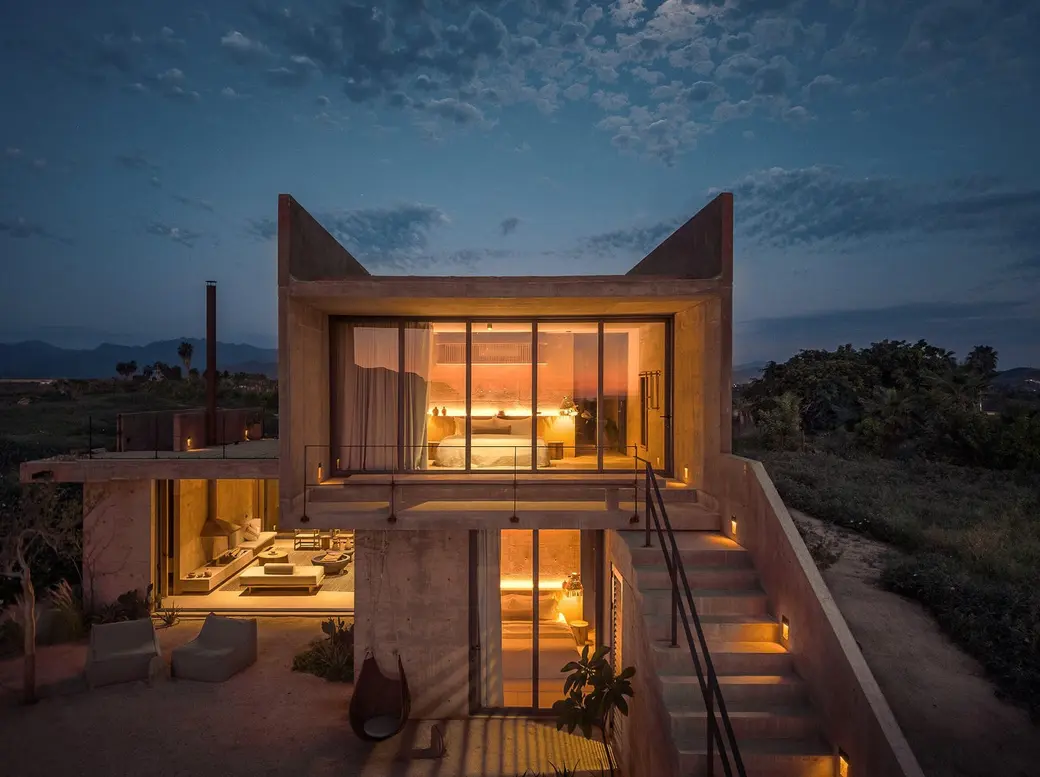
The Architecture of Paradero Homes: Why the Most Powerful Design Goes Unnoticed
Most luxury real estate in Los Cabos announces itself. Grand entrances, dramatic cantilevers, maximalist finishes competing with the view. The message is: look at what was built here.
Gabriela Carrillo, the Mexico City architect behind Paradero Homes in Pescadero, works from the opposite premise.
"The most powerful architecture," she says, "is that which runs the risk of going unnoticed, but has the ability to place you in a position where you could not be before."
That single sentence explains everything about what makes these homes different.
Honoring What Was Already There
When Carrillo approached the site in Pescadero, she didn't start by designing. She started by looking.
"The components were already laid out," she says. "It was not very difficult to simply honor everything that was around me and recognize things that are later forgotten."
What she noticed was what most developers overlook: not just the sea, but the mountain system in the distance, the palm groves between, the way the territory layers itself from coast to high ground. The homes reflect all of it. They don't compete with the landscape. They frame it.
This is harder than it sounds. Restraint in architecture requires more confidence than spectacle. Anyone can add. The discipline is in knowing what not to touch.
Doing a Lot With Little
Carrillo's design philosophy is rooted in minimalism — but not the sterile, museum-like minimalism that makes spaces feel untouchable.
"The most powerful things on Earth are the minimal ones," she says. "And doing a lot with little is really complex."
At Paradero, that complexity plays out in the handling of light and plane. A single wall, properly positioned, can receive light in the morning, cast deep shadow by afternoon, and create a sense of depth and density that no amount of ornament could achieve. The architecture understands that a surface is not passive — it's a participant.
The portico is the clearest example. Carrillo describes it as a millenary principle: a roof that lets wind circulate, creates shade, and extends further on one side because of how the sun moves. It's almost primitive in concept. But the execution — the ability to open and close spaces using curtains, glass panels, movable elements — turns that ancient idea into something genuinely contemporary.
"The curtains are these movable pieces that give you flexibility," she explains. "Suddenly I can open a pane of glass, but I draw the curtain and then the dining room becomes a contained scene between two walls, with sand, on sand."
The curtain, in her words, acts as a veil — a transition between the interior world and the landscape beyond. It doesn't block the outside; it mediates your relationship with it.
Spaces That Transform
One of the most important ideas in Carrillo's work is that a space should be capable of becoming something different depending on how it's used.
"Spaces have a posture," she says. "They have a will to happen in a certain way, but the idea is that this space be inhabited and transformed."
This is what separates architecture from decoration. Decoration fixes a room in one state. Architecture gives a room the capacity to shift — with light, with wind, with the movement of a curtain, with the season. The homes at Paradero are designed to feel different at 7am than they do at sunset. Different when you're alone than when the whole family is there.
That quality of transformation is also what creates intimacy. Not by closing things off, but by giving spaces the tools to become contained when you need them to be, and open when you don't.
"Intimacy is important, particularly in a house," Carrillo says. "Having that versatility and that possibility of being transformed is a very powerful place."
Points of Intersection
Perhaps the most revealing thing Carrillo says is about what she actually looks for when designing.
"The point of intersection between the landscape and the wall, the point of intersection between the wall and the sand, where that wall is wrapped by it, the point of intersection between a piece for bathing and the entrance of light through a latticework to encounter a courtyard — those points of intersection are what I think the house achieves."
It's a useful lens for understanding what you're experiencing when you walk through one of these homes. What feels like simplicity is actually a series of precisely engineered thresholds — moments where one element meets another and something unexpected happens. Light hits sand. Wall meets sky. Interior opens to exterior without a hard edge.
"Despite being such a simple scheme," she says, "it always finds an intersection with something that was already there."
What This Means for Buyers
Carrillo is one of Mexico's most recognized architects. Her work has been exhibited internationally and earned Paradero Hotel multiple design awards. The residences at Paradero are not developer spec homes with architect credits on the brochure. They are genuinely authored buildings — the product of a specific intelligence applied to a specific place.
That matters for resale. It matters for rental rates. And it matters for the experience of actually living in them.
When you buy at Paradero, you're not just buying square footage and a hotel rental program. You're buying a building that was designed to place you in relationship with one of the most beautiful stretches of coastline in Baja — and to keep doing that, quietly, every day.
That's what good architecture does. You stop noticing it, and start noticing everything else.
For more information on Paradero Homes in Pescadero, contact Francesco Lee. REmexico Real Estate represents buyers throughout Baja California Sur.
Francesco Lee - francesco@caborealestate.com
Categories
- All Blogs (230)
- Agent Training (5)
- Cabo Golf (12)
- Cabo Legal (36)
- Cabo Real Estate (100)
- Cabo Restaurants (3)
- Commercial Real Estate in Cabo (4)
- Construction (18)
- Destination News (21)
- East Cape (8)
- Financing (3)
- Land Banking (2)
- Loreto (2)
- Luxury Homes in Cabo (11)
- Market Report (5)
- Mulege (2)
- Neighborhoods (3)
- Pre-Construction (17)
- Remexico Real Estate Agents (3)
- Residency (2)
- Sports (6)
- Taxes (5)
- Todos Santos (7)
Recent Posts





GET MORE INFORMATION
