
Stop Selling, Start Advising: What a Top Denver Agent Taught Our Team About the Future of Real Estate
Los Cabos Real Estate: Why Great Agents Are Advisors, Not Salespeople
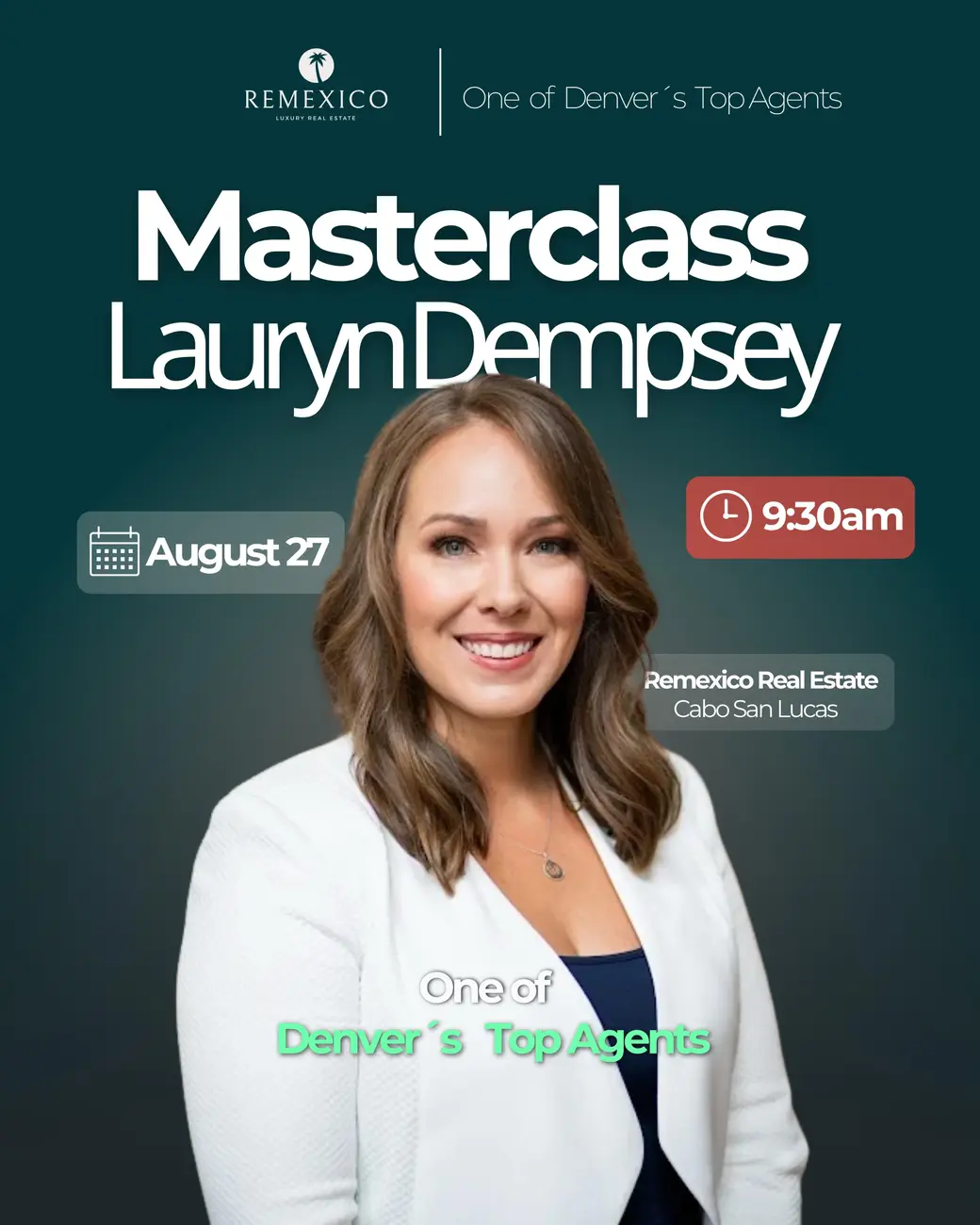
Every few months, we bring in an outside voice to challenge how our team thinks and operates. Recently, that voice was Lauryn Dempsey, a solo real estate agent from Denver, Colorado, who has sold more than 200 homes and consistently closes $17–$20 million in annual sales without a team, without discounting her commission, and, importantly, without allowing the business to consume her life.
Before entering real estate, Lauryn spent 14 years in the U.S. Navy, where she piloted warships and later advised senior leaders on crisis communications at the Pentagon.
We invited Lauryn to speak with our real estate team in Los Cabos about what she has learned, what has allowed her business to remain sustainable, and where she believes the real estate industry is headed.
What she shared wasn't just relevant to real estate agents. It applies equally to buyers and sellers deciding who they want representing them in one of the largest financial transactions of their lives.
Real Estate Has a Burnout Problem
Lauryn's wake-up moment came early in her career.
After selling 40 homes in her first year, she attended an industry awards ceremony and found herself sitting with some of the top-producing agents she had admired.
But as she got to know them, she noticed something troubling.
Some had achieved incredible production numbers while their marriages, health, and relationships with their children had suffered. They had succeeded by nearly every traditional real estate metric, but in some cases, that success had come at an enormous personal cost.
The problem wasn't necessarily the people. It was the model.
Traditional real estate often rewards constant activity: more leads, more calls, more showings, more marketing, more transactions, and more production.
Activity becomes confused with progress.
Lauryn describes the result as a "transactional spin cycle," where agents chase leads, lenders chase agents, and consumers are caught in the middle trying to determine who they can actually trust.
There is a better approach.
Buyers and Sellers Have More Information Than Ever
Real estate information used to be difficult to access.
Today, buyers can search listings, compare neighborhoods, study historical sales, research mortgage rates, review market statistics, watch property tours, and ask AI increasingly sophisticated questions about almost any real estate market in the world.
The challenge is no longer finding information.
The challenge is knowing what information actually matters.
Most buyers and sellers we work with aren't suffering from a lack of data. In many cases, they have too much of it.
What they need is someone who can put that information into context and explain what it means for their particular situation.
That is where an experienced real estate advisor becomes valuable.
Technology can analyze information and make research dramatically easier, but important real estate decisions still benefit from experienced judgment. Sometimes the most valuable advice an agent can give a client is not which property to buy, but which property not to buy.
A good advisor needs to be willing to say:
Walk away from this deal.
Don't overreact to this inspection report.
This property is overpriced.
This "great deal" has risks you may not be considering.
Don't panic and lower your price.
You have more negotiating leverage than you think.
That judgment comes from experience: transactions that went smoothly, transactions that didn't, difficult negotiations, inspections, title problems, changing markets, and years of seeing what happens after the contract is signed.
The Three Things That Separate Good Agents From Great Advisors
Lauryn breaks the difference down into three areas: orientation, structure, and skill.
Orientation
Orientation is the intent behind how an agent operates.
Is the goal simply to close another transaction, or is it to help the client make the best decision possible?
Clients can usually feel the difference.
An advisor should be comfortable recommending that a client not buy a property when the deal doesn't make sense, even when doing so means losing a commission.
Trust is built when the client's interests clearly come before the transaction.
Structure
Structure means deciding who you work with, how you operate, and what you are willing to say no to.
Not every client-agent relationship is a good fit.
Agents who attempt to work with everyone often end up providing mediocre service to too many people. Protecting time and creating systems allows an agent to provide significantly better service to the clients they do represent.
The goal isn't necessarily to do more transactions.
It's to do a better job on the transactions you choose to take on.
Skill
Good intentions aren't enough.
An advisor still needs market knowledge, negotiation experience, systems, relationships, and the ability to solve problems when transactions become complicated.
The best agents combine the right orientation with the structure and skills required to consistently deliver for their clients.
When those three things work together, the relationship changes.
The agent stops being someone who simply provides access to properties and becomes someone the client trusts to help make the decision.
Why This Matters Even More When Buying Real Estate in Los Cabos
Buying real estate in Mexico can involve complexities that many foreign buyers have never encountered.
Depending on the transaction, buyers may need to understand fideicomiso structures, Mexico's restricted zone, the role of the notario público, closing costs, title verification, escrow, currency exposure, property inspections, HOA rules, insurance, and differences between Mexican and U.S. real estate practices.
Pre-construction real estate in Los Cabos can introduce another layer of considerations, including developer contracts, construction timelines, payment schedules, delivery requirements, condominium regimes, warranties, and eventual title transfer.
This is exactly the type of environment where judgment matters more than simply having access to information.
Anyone can find Los Cabos real estate listings online.
The more important questions are often harder:
Is the property priced correctly?
Is the developer financially and operationally capable of delivering what they're promising?
Is there a title or legal issue that deserves additional investigation?
What should you negotiate before signing?
Does the projected rental income actually make sense?
Is a resale property a better value than pre-construction?
When should you push harder in a negotiation, and when should you simply walk away?
Those answers rarely come from a listing sheet.
They come from experience.
The Future of Real Estate Is Advice, Not Access
Technology will continue changing real estate. Buyers and sellers will have access to more information, better tools, more sophisticated property searches, and increasingly powerful AI.
That's a good thing.
But as information becomes easier to obtain, simply having access to listings becomes less valuable.
Judgment becomes more valuable.
That's the model we're continuing to build at REmexico Real Estate: fewer transactions driven by pressure and volume, and more relationships built around trust, experience, transparency, and real problem-solving.
Because ultimately, a great real estate agent shouldn't just help you find a property.
They should help you make a better decision.
Lauryn Dempsey - lauryn@lauryndempsey.com
Fletcher Wheaton - fletcher@remexico.com
Categories
- All Blogs (232)
- Agent Training (5)
- Cabo Golf (12)
- Cabo Legal (36)
- Cabo Real Estate (101)
- Cabo Restaurants (3)
- Commercial Real Estate in Cabo (4)
- Construction (18)
- Destination News (21)
- East Cape (8)
- Financing (3)
- Land Banking (2)
- Loreto (2)
- Luxury Homes in Cabo (11)
- Market Report (5)
- Mulege (2)
- Neighborhoods (3)
- Pre-Construction (17)
- Remexico Real Estate Agents (4)
- Residency (2)
- Sports (6)
- Taxes (5)
- Todos Santos (7)
Recent Posts







GET MORE INFORMATION
